Tamina Lolev RO
https://noddesignlab.ro/, https://nodmakerspace.ro/, https://materlibrary.ro/en/mater/, https://dambovitaapadulce.ro/
Splaiul Unirii 160, sector 4 | 040041 Bucuresti
Tamina Lolev — About Me
I am an architect by training and an urban activist by conviction.
Over the past 14 years, I have worked at the intersection of architecture, urban design, community facilitation, and cultural management — in a practice that resists the boundary between drawing and doing.
My starting point is always the city as a living process: something that is built through testing, dialogue, and learning, not through finished plans delivered from above.
---
What I Do
I co-initiate and lead projects that prototype the city together with the people who live in it. My work spans the full range from field research and participatory facilitation, through design and hands-on construction, to cultural activation and long-term stewardship of spaces.
The methodology I work with — and that I co-developed at Nod Design Lab — follows a deliberate sequence: **Listen → Co-design → Prototype → Build → Activate → Learn & Iterate**. These steps are not linear. We move back and forth between them, adjusting direction based on what we learn from real use.
This approach is not just a process preference. It is a position: most urban solutions need to be tried, not just planned. The prototype is the primary instrument of dialogue and learning.
---
Philosophy
I am guided by a set of values that shape every project I am part of: integrity in the way I work with people and institutions, collaboration as a non-negotiable condition for meaningful impact, creativity and innovation as tools for solving real problems and leadership as the responsibility to move things forward when no one else will.
I believe that good urban spaces are not designed for communities — they are designed *with* them. The most durable interventions are those that are collectively owned, tested at small scale before being locked in, and activated continuously rather than inaugurated once.
I am drawn to underused, under-loved, or contested spaces — industrial buildings, riverbanks, vacant lots, forgotten infrastructure — and I work with multidisciplinary coalitions to reveal their potential. My projects tend to begin with listening, not with concepts.
I am also convinced that architecture and cultural management are not separate disciplines. The way a space is programmed, curated, and cared for over time is as important as the way it is built.
---
Key Projects
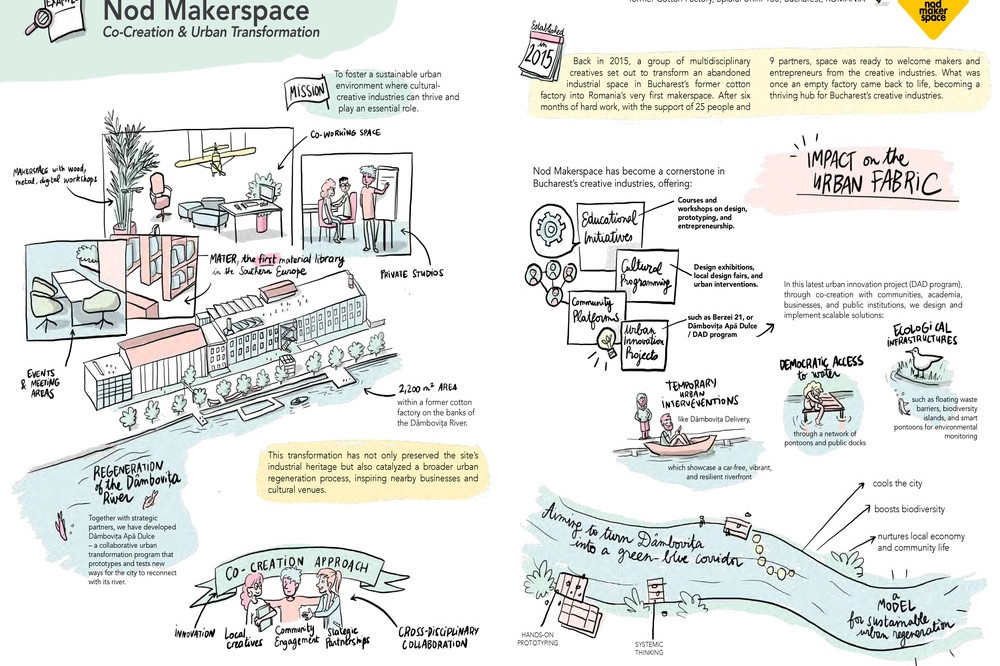
Nod Makerspace and the former Cotton Factory (2014–present) — Co-founder of Bucharest's innovative makerspace, housed in a converted industrial hall. Nod is a basecamp for urban experimentation, creative production, and civic initiative. Over ten years, it has grown into an ecosystem: Mater (a materials library and research tool), La Firul Ierbii (a community hub for civic initiatives), and a network of collaborators spanning design, technology, and social innovation.
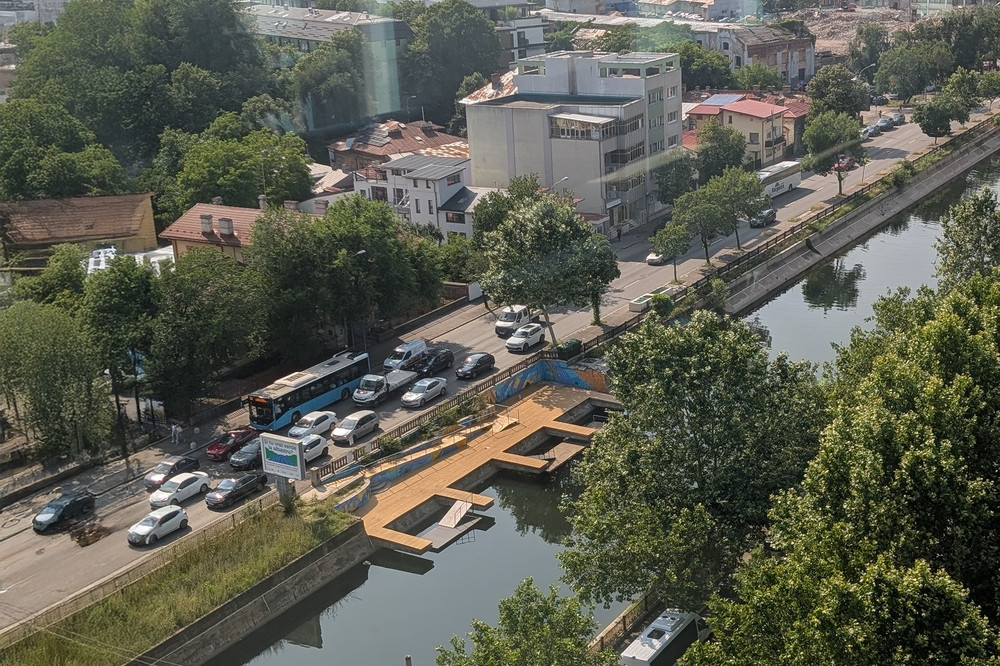
Dâmbovița Delivery manifesto / Dâmbovița Apă Dulce program (2020–present) — A multi-year multistakeholder collaboration and an urban prototyping programme focused on reconnecting Bucharest with its river. What began as a one-weekend event-manifesto evolved into a structured collaborative effort: floating platforms, waste management barriers, a biodiversity island, riverside access points, and 35,000 participants over the course of the programme. Currently scaling through a consortium of NGOs, institutions, and public administration, with an international ideas competition as a long-term visioning tool.
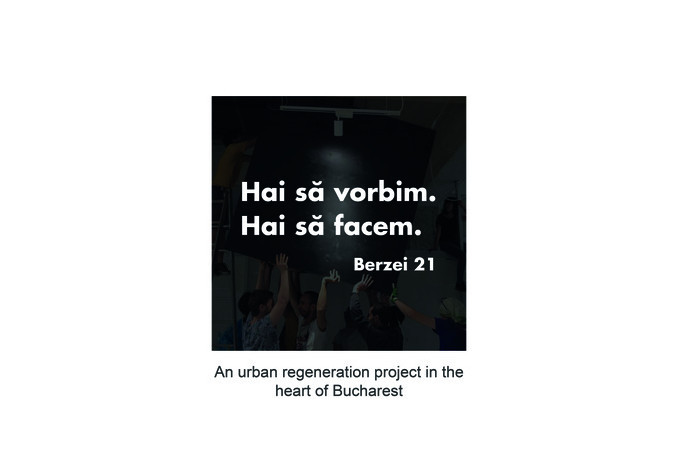
**B21 Cluster** (2021–2022) — Co-initiator of a civil society coalition dedicated to transforming a historic under-used industrial complex in the heart of Bucharest into a mixed-use hub for cultural production, education, and community life. Berzei 21 (the place) is a mixed-use adaptive reuse of a historic Bucharest former industrial asset, developed as a regional collaborative creative hub.
CECCUD Exchange Programme (2024–2025) — Project lead for a knowledge exchange between Nod Makerspace, La Friche la Belle de Mai (Marseille), and the Bucharest City Hall. The programme focused on building sustainable cultural and creative urban ecosystems through participatory governance.
Mater — Materials Library (2018–present) — Co-founder of a research and educational tool for materials, adjacent to the makerspace. A resource for designers, architects, and students that makes the material world tangible and accessible.
---
How I Work
I bring together actors who do not usually speak the same language: citizens, public administration, experts, artists, developers. My role is often to translate between these registers — civic, technical, institutional, creative — and to build the trust needed for shared decisions.
I am a facilitator as much as a designer. I run participatory workshops, public consultations, and co-creation sessions. I also speak publicly about urban regeneration, cultural ecosystems, and civic space — at conferences, TED talks, and policy forums.
I work hands-on. Many of the spaces I have been involved with, I have also helped build — physically, on site, with teams of volunteers and collaborators.
---
Background
MArch, Ion Mincu Architecture and Urbanisme University and École Supérieure d'Architecture Saint-Luc Liège, Belgium (2006–2012. Early career experience in Shanghai at NITA Design Group, working on urban landscape research and concept design at multiple scales.
Awards include 1st prize at the Kiev Islands International Masterplan Competition (2012), 2nd prize at two national architecture and urban design competitions (2012, 2013), and 2nd prize at the Timișoara Arts, Technology and Experiment Centre competition (2020).
Consultant to the World Bank on urban design.
---
Skills
Architecture · Urban Design · Project Management · Participatory Facilitation · Cultural Management · Public Speaking · Creative Concept · Community Building · Design & Build · Research
---
Bucharest, Romania
tamina@nodmakerspace.ro