Snezana Petrovic RS
https://www.linkedin.com/in/snezana-petrovic-arch/
Otona Zupancica 28 | 11000 Belgrade
Snezana Petrovic, M.Arch. | Principal Architect | Private Practice, Belgrade, Serbia
Faculty of Architecture, University of Belgrade (1996) | IKS License 300 – Lead Designer | IKS License 400 – Lead Contractor
Architecture, for me, has always been a story about people, memory, and the quiet dignity of space. Rooted in sustainability and human development, it reaches far beyond what we call art or engineering. Through three decades of practice, I have learned that every building carries its own story. My role is to listen, to respect, and to give that story a considered continuation.
My journey began in Belgrade, surrounded by the raw modernist poetry of post-war architecture. Even before I entered the Faculty of Architecture, I understood that architecture was a universal language, one that transcends borders, politics, and time. After graduating, I spent two years as a junior research assistant at the Department of Urban Planning, teaching and mentoring students.
Selective competitions have consistently marked my path: two first prizes in international urban planning competitions in Senegal, for the Rufisque City Center and Independence Square in Dakar, realized for the Parisian firm Batirenov (2003). The Dakar project was published on the front page of the Senegalese journal Dakar Ville (No. 13, June 2003). Both projects were realized in collaboration with arch. A. Damjanović. These projects confirmed what I already believed: architecture is a cultural, social, and deeply human act. A first prize for the Main Town Square in Čačak (2000) and fourth place at the International Architecture Biennale in Kraków (2000) showed that this recognition was not accidental. Large-scale urban planning projects I have always realized as part of multidisciplinary teams.
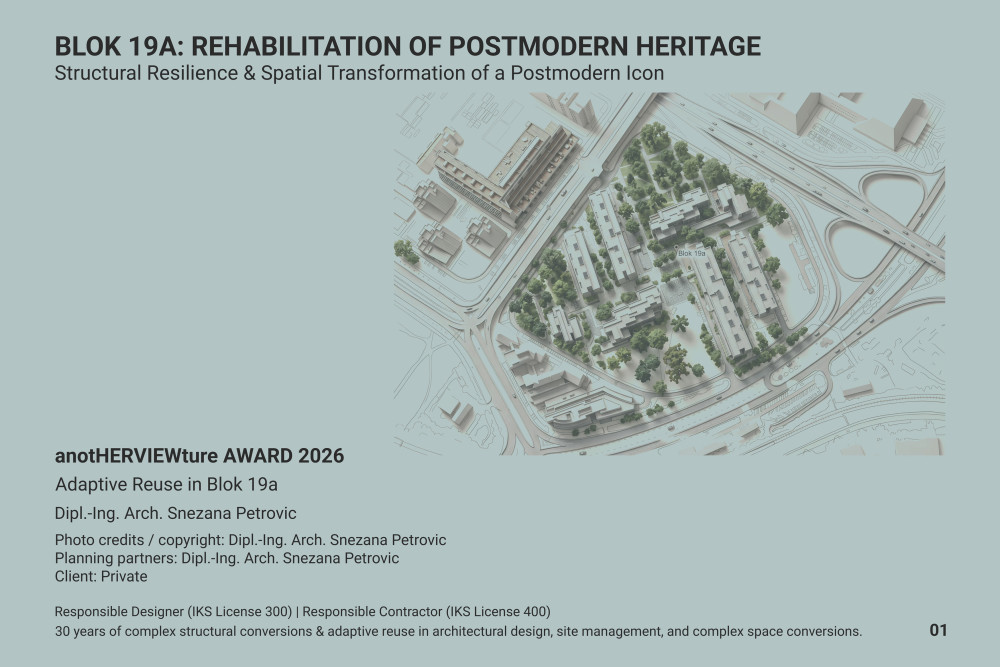
The project that most shaped my thinking was a 1978 building in Block 19a, a concrete embodiment of Yugoslav postmodern optimism. The task was to divide one 95-square-meter apartment into two, leaving every column, shear wall, vertical shaft, and seismic slab entirely intact. That became my manifesto: the most sustainable building is the one that already exists. At a time when needs and habits are shifting and commercial spaces are seeking new purpose, I increasingly work on converting them into residential units, finding in existing structures a potential that awaits new life. For me, this is not an abstract principle but a concrete engineering practice.
My technical practice spans structural coordination, seismic compliance, and adaptive reuse of existing building stock. I work across the full project cycle, from feasibility and conceptual design through construction documentation and site supervision, with a consistent focus on material efficiency and long-term performance. This includes leading the interior design and site supervision of over 70 retail facilities across Serbia and Greece, where precision, cost control, and strict regulatory compliance were non-negotiable.
Through the German NGO HELP – Hilfe zur Selbsthilfe, I assessed, designed, and supervised the reconstruction of approximately 30 housing units for vulnerable communities across Serbia. Every field visit reminded me that a technical solution is only as valuable as the dignity it brings to those who live in it.
I remain unwavering in my belief that architecture is the art of giving new life to buildings, communities, and people. It is my honor to share this story with you, and if it encourages even one young woman to see engineering and architecture as her path, it will have found its deepest meaning.